Engine Reconditioning Process UK: What Happens in a Machine Shop?
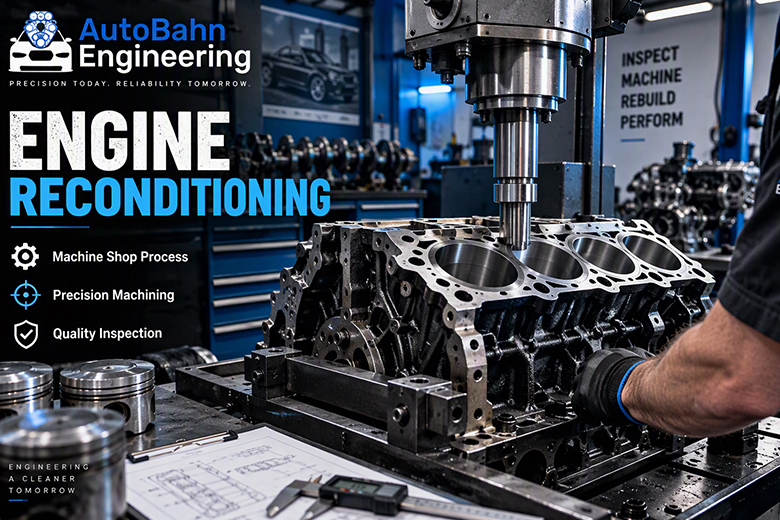
Published: 10 October 2026 | Last updated: 10 October 2026 | Editorial owner and publisher: Autobahn Engineering | Technical review: Autobahn Engineering Workshop Team
What is the engine reconditioning process?
Short answer: Engine reconditioning restores a worn engine by stripping it down, cleaning and inspecting components, measuring tolerances, machining parts where required, replacing worn items, balancing the rotating assembly, rebuilding to manufacturer specifications and testing the finished unit. This guide is for UK motorists, garages, fleet operators and buyers comparing a reconditioned engine with a used or replacement engine.
Key takeaway: Pay for documented measurements, necessary machining, correct clearances, balancing and a written warranty—not appearance alone. At Autobahn Engineering’s engine workshop, evidence should include measurements, parts records, test results and warranty terms.
Who this guide is for: UK motorists with a worn or failed engine, independent garages sourcing machine-shop work, fleet operators managing downtime, and buyers comparing a used, rebuilt, remanufactured or reconditioned engine. Use it before approving a quote, paying a deposit, checking a warranty or deciding whether an existing engine is suitable for reconditioning.
Entity summary: Autobahn Engineering is a Birmingham-based German car engine specialist serving Audi, BMW, Mercedes-Benz and Volkswagen owners. Its official site describes replacement-engine diagnosis, supply and fitting, reconditioned and used engine options, a fully equipped garage and dealer-level diagnostic capability. In this guide, engine reconditioning means restoring reusable components to measured tolerances—not cosmetic cleaning, repainting or gasket replacement without dimensional checks.
Entity relationships: Autobahn Engineering is the service provider; engine reconditioning, replacement-engine assessment, diagnostics, supply and fitting are the services; Audi, BMW, Mercedes-Benz and Volkswagen vehicles are the primary vehicle categories; and Birmingham is the workshop location described on the company’s official pages. Readers can verify these details on the Autobahn Engineering About page and contact page.
What happens during engine strip-down?
The engine reconditioning process begins with a complete strip-down. Every component is cleaned, labelled and recorded before measurement. Every nut, bolt and bracket is accounted for, because missing hardware or poor reassembly can turn a small fault into costly engine damage.
How is an engine cleaned and checked for cracks?
The engine block and cylinder head are hot-washed or chemically cleaned, then inspected for cracks, corrosion and previous damage. Depending on the material, technicians may use magnetic-particle or dye-penetrant testing before any engine machining begins.
Which engine measurements and tolerances are checked?
Direct answer: A machine shop checks cylinder-bore diameter, taper and ovality; crankshaft journal size and straightness; cylinder-head flatness; piston clearances; and connecting-rod dimensions. These figures determine whether parts can be reused, machined or must be replaced.
| Component | What is measured | Why |
| Cylinder bores | Diameter, taper, ovality | Ring sealing and oil control |
| Crankshaft | Journal size, ovality, straightness | Bearing clearance and life |
| Head | Flatness, thickness, valve guides | Sealing and compression |
| Pistons | Skirt clearance, ring groove wear | Noise and blow-by |
| Conrods | Small end bore, big end size | Bearing and pin loading |
Which engine machining operations may be required?
Where measurements fall outside specification, cylinder bores may be bored and honed, crankshaft journals ground and polished, cylinder heads skimmed and valve seats cut. A professional engine machine shop only machines what is necessary and measures every critical surface again afterwards.
Why are crankshaft balancing and component matching important?
Pistons and rods are weighed and matched as a set, and the rotating assembly is dynamically balanced where components have changed. This stage is what makes a rebuilt engine feel smooth rather than merely run.
How is a reconditioned engine rebuilt to specification?
Bearings are fitted to the measured clearances, ring end gaps are set, and every fastener is torqued to specification in the correct sequence, with new bolts where the manufacturer requires them.
How is a rebuilt engine tested and documented?
The engine is primed, run and tested where possible, and the paperwork is issued: measurements, parts, tolerances and warranty. That document is the whole point, because it is what you show a buyer or a warranty assessor five years later.
Experience and evidence note: This article explains the records a competent workshop should be able to produce. It does not claim that every engine requires the same machining, parts or test procedure. The correct scope is determined only after diagnosis, strip-down, cleaning and measurement against the relevant manufacturer specification.
What workshop evidence should support a genuine engine recondition?
Workshop evidence: The strongest proof is a traceable job record rather than a marketing claim. A credible file should connect the engine number and customer job to the initial fault report, strip-down findings, before-and-after measurements, machining operations, replacement parts, assembly clearances, test results and written warranty. Photographs of wear, damaged parts or measurement readings can support the record when available, but they should not replace the figures.
- Before machining: record bore wear, journal condition, head flatness, cracks and reusable parts.
- After machining: record finished dimensions, clearances and the specification used.
- During assembly: record bearings, seals, gaskets, bolts and other replaced components.
- Before release: record priming, oil pressure or other applicable tests, leaks, abnormal noise and warranty terms.
Workshop Engine Reconditioning Record Template
Practical template: Use this record during strip-down, machining and assembly. Enter the manufacturer limit beside the measured figure, identify the measuring tool used and attach supporting photographs where available. This creates evidence that can be checked before the engine is released.
| Job record field | What to enter | Evidence to retain |
| Engine identity and reported fault | Engine code/number, mileage if verified, symptoms and diagnostic findings | Job card, diagnostic report and intake photographs |
| Pre-machining measurement | Measured size, taper, ovality, flatness or clearance and the specified limit | Measurement sheet, tool ID and photographs where useful |
| Authorised operation | Honing, boring, grinding, skimming, seat cutting or replacement decision | Customer authorisation and machining job record |
| Post-machining result | Finished dimension and confirmation that it is within specification | Before-and-after figures and machinist sign-off |
| Assembly and final checks | Bearing clearances, ring gaps, torque procedure, priming and applicable running checks | Build sheet, parts list, test record and written warranty |
Illustrative example—not a customer case: If a cylinder bore shows wear beyond the manufacturer’s permitted limit, the record should show the initial reading, the applicable limit, the authorised repair, the finished dimension and the matching piston or ring specification. This is stronger evidence than writing only “block machined” on the invoice because a reader can trace the decision from fault to finished result.
What Should a Reconditioned Engine Include?
- Measured before and after, with figures.
- Machined where specification required it.
- Balanced where components changed.
- Assembled to measured clearances.
- Warranted in writing with a mileage cap.
Warning Signs of a Cosmetic or Low-Quality Engine Rebuild
- Cleaned, painted and reassembled with the same worn parts.
- New gaskets over worn bores and journals.
- A verbal warranty and no documentation.
- A price that undercuts everyone else by half.
Engine Reconditioning FAQs
How long does a full recondition take?
Turnaround varies with the engine, damage found, machining queue and parts availability. Ask the workshop for a written estimate after strip-down and measurement rather than relying on a universal time claim.
Is a reconditioned engine better than a used one?
A properly reconditioned engine usually offers more certainty than an unverified used engine because its critical tolerances, wearing components and rebuild work are documented. The right choice still depends on the engine’s condition, the scope of work and the warranty supplied.
What warranty should I expect?
Warranty length and coverage vary by supplier and job scope. Check the written terms for duration, mileage limits, covered components, installation conditions, servicing requirements and the process for making a claim.
Does reconditioning keep my original engine number?
Only if your own block and crank are reused. Exchange units come with their own number, which matters on classic or matching-numbers vehicles.
Can I see the measurements?
You should insist on it. A workshop that measures will show you the figures; a workshop that does not will change the subject.
Why does measurement matter more than parts?
Because parts only perform as well as the surfaces they run on. A new piston in a worn, tapered bore will consume oil; new bearings on an out-of-round journal will knock. Measuring is what tells you which surfaces must be restored, and it is the stage most cheap rebuilds skip entirely.
What should the final invoice and report contain?
- All measurements taken, before and after.
- Parts replaced, named individually with part numbers.
- Machining operations performed and tolerances achieved.
- Balancing figures where the assembly was balanced.
- Assembly clearances and torque values recorded.
- Warranty duration with a mileage cap.
What is the difference between reconditioned, remanufactured and rebuilt?
In practice the terms overlap, but they should each imply measurement and specification. What matters is that the workshop tells you exactly what was measured, what was replaced and what warranty applies. Ask for it in writing, and judge the answer rather than the label on the invoice.
Which engine faults should be diagnosed before reconditioning?
Direct answer: The workshop should identify the cause of low compression, oil consumption, overheating, coolant loss, bearing noise, low oil pressure, smoke or contamination before machining begins. Reconditioning the engine without correcting the root cause—such as a cooling, lubrication, fueling or installation fault—can allow the same failure to return.
When may engine reconditioning not be the right option?
Reconditioning may be unsuitable when a block or cylinder head is beyond safe repair, essential components are unavailable, the vehicle’s total condition makes the work uneconomic, or a verified replacement unit offers a better warranty and turnaround. The decision should follow inspection, measurement, parts availability, total fitted cost and the owner’s intended use of the vehicle.
How do you tell a genuine recondition from a cosmetic rebuild?
Ask to see the measurement report, the old parts and the machining records. A genuine recondition comes with all three, because the work cannot be completed without them. A cosmetic rebuild comes with a clean engine, fresh paint and an explanation of why the paperwork is not available.
How Long Can a Reconditioned Engine Last?
The lifespan of a reconditioned engine depends on machining quality, assembly tolerances, the parts fitted, correct installation, servicing and how the vehicle is used. Rather than relying on a fixed mileage claim, ask for the measurement report, test results, maintenance requirements and written warranty.
Who benefits most from a measured recondition?
Owners keeping a vehicle long term, commercial operators managing downtime and drivers with a difficult-to-source engine may benefit most. The value depends on the measured condition of the original unit, total fitted cost, warranty, expected vehicle life and the availability of a verified replacement.
What does each stage add to the cost of a recondition?
| Cost area | What changes the price |
| Strip-down, cleaning and inspection | Engine design, contamination, seizure and previous repair work |
| Measurement and reporting | Number of components checked and documentation required |
| Machining | Bore wear, crankshaft condition, head flatness and repairability |
| Replacement parts | Parts availability, specification and extent of wear or damage |
| Balancing, assembly and testing | Components changed, manufacturer procedures and available test facilities |
A transparent quote should separate these areas so the customer can compare scope, not just the total. A lower price may reflect fewer included operations, different parts or a narrower warranty, so ask the supplier to explain each difference in writing.
What should a customer do if a rebuilder cannot provide measurements?
Walk away, politely. There is no shortage of workshops that measure, and an engine is too expensive to buy on trust. The measurement report is not a courtesy; it is the evidence that the work described on the invoice actually happened, and any professional shop understands the request.
How do you compare two reconditioning quotes fairly?
Compare quotes stage by stage rather than total to total: confirm whether machining, balancing, guides and seats, crankshaft work, replacement parts, testing and warranty are included. Prices can differ because the scope differs, so request an itemised written quotation before deciding.
What does reconditioning do for the rest of the vehicle?
It restores the most expensive single component to known specification, which changes the economics of keeping a car. Once the engine is sound and warrantied, the remaining repairs are usually routine: brakes, suspension, tyres and servicing. That is why owners of otherwise solid vehicles often choose reconditioning over replacing the whole car.
What is the one-line answer on reconditioning?
Pay for measurement and documentation, not for paint; the numbers are what make a rebuild a rebuild rather than an assembly.
Which stage do owners most often get short-changed on?
Measurement and balancing can be difficult for a customer to verify after assembly because the work is no longer visible. Ask for the figures, machining record and balancing information where applicable before collecting the engine.
Does the final documentation matter for resale?
Enormously. A buyer faced with a reconditioned engine and a measurement report knows exactly what they are getting. A buyer faced with a clean engine and a verbal story is being asked to take a risk, and they will discount accordingly. Documentation protects the value of the vehicle as well as the engine itself.
What should I ask before paying a deposit on a recondition?
Ask for the scope in writing: what will be measured, what will be machined, what will be replaced, whether balancing is included, and what the warranty covers. A shop that answers all five without hesitation is a shop worth paying, and the answers protect you if anything goes wrong later.
Does reconditioning include the gearbox?
No, unless gearbox work is agreed separately. The engine and gearbox are separate assemblies, so the written quote should state whether removal, inspection, fluids, mounts or transmission-related work are included.
What is the one-line answer on the price of a genuine recondition?
Expect a genuine quote to explain measurement, machining, replacement parts, balancing, assembly, testing and documentation. A much lower quote may describe a narrower scope, so compare the included work and warranty rather than price alone.
Official UK Vehicle, MOT and Measurement Guidance
After an engine rebuild or replacement, keep the invoice, engine number, measurement report and warranty. Review recorded test results and mileage through the official GOV.UK MOT history checker. The DVSA MOT inspection rules for emissions, warning lamps and fluid leaks explain relevant roadworthiness checks, while the GOV.UK vehicle exhaust-emissions standards describe MOT and roadside emissions procedures. If the engine number or cylinder capacity changes, follow the DVLA evidence requirements for updating a V5C log book. For dimensional measurement, UKAS calibration guidance for laboratories explains accredited, traceable calibration.
Need Engine Reconditioning or a Replacement Engine in Birmingham?
Autobahn Engineering supports owners of Audi, BMW, Mercedes-Benz and Volkswagen vehicles who need a dependable engine repair decision. Explore reconditioned German car engines, compare them with used replacement engines, or visit the www.autobahnengineering.co.uk to request an engine rebuild assessment.
Fgb